For children, the approach is especially gentle. Often needle-free (point stimulation, massage), it supports a still-developing constitution.
In children, acupuncture addresses a constitution that is still forming. Here are the most common reasons for consultation, and how it can help.
Difficulty falling asleep, night waking, evening restlessness: in children, in Chinese medicine, these often reflect a mild imbalance that responds well to gentle techniques. A few sessions are often enough to restore steadier sleep.
Repeated colds, ear infections or throat infections suggest, in Chinese medicine, an under-toned defensive energy (Wei Qi). Regular support, particularly between acute episodes, can help space out infections, alongside the child’s usual paediatric or GP follow-up.
Bedwetting that persists past the age when night-time bladder control is usually achieved can, in Chinese medicine, be associated with a weakness of Kidney Qi. Acupuncture, always offered gently and without drama, can support the child towards better control, in coordination with the paediatrician if needed.
A needle-free approach: for children and teenagers, needle-free techniques are favoured as much as possible — gentle point stimulation, massage and paediatric Tui Na. The technique is adapted to each child’s age and sensitivity, always explained simply to both child and parents, so the session stays a reassuring moment.
Depending on age, needle-free techniques are favoured: gentle stimulation, point massage (paediatric Tui Na). The session is short, playful, and always explained to both child and parents.
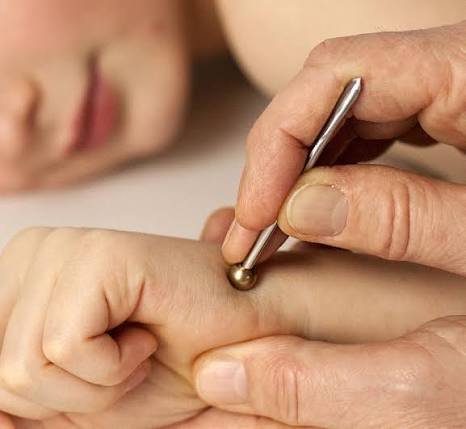
For young children, needle-free techniques are mainly used. Gentleness always comes first.
Treatment is possible from infancy, using adapted techniques. The approach evolves as the child grows.
Shorter than for an adult, to respect the child’s attention span.
No. It is a complement. Regular paediatric follow-up remains essential.