The most fundamental principle of Chinese medicine: a dynamic balance between two poles that complement, limit and transform into one another.
By Dr Alexandre Fleury · Physician acupuncturist · ~5 min read
 Foundations of TCM
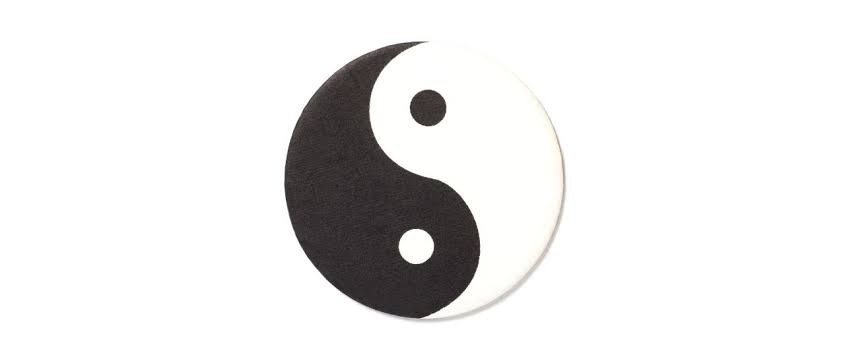
Yin and Yang are often presented as “opposites”, but the central idea in Chinese medicine is really one of dynamic balance: each contains a part of the other and transforms into it, just as day turns into night without any sudden break. The Taiji symbol (the “Yin-Yang”) illustrates this idea: a light point within the dark half, a dark point within the light half.
Yin represents what is cool, calm, internal and nourishing: night, rest, the body’s fluids, matter, turning inward. Yang represents what is warm, active, external and dynamic: day, movement, body heat, function, outward expression.
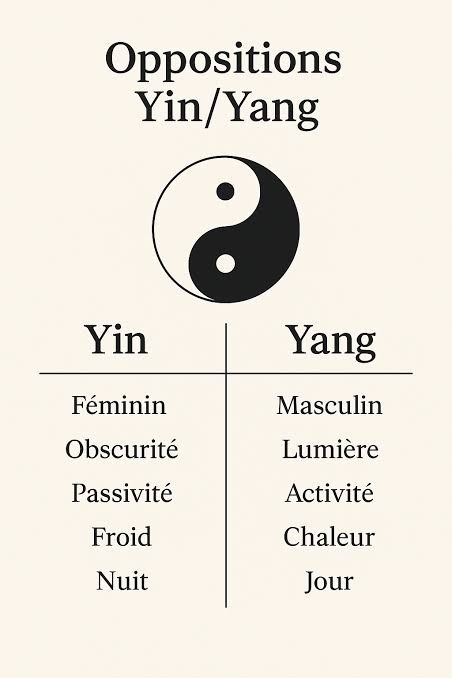
Nothing is ever absolutely Yin or Yang: it is always a relationship. Water is Yin relative to fire, but boiling water is more Yang than ice-cold water. The body itself can be read through Yin and Yang: the interior (Yin) and the surface (Yang), the lower body (Yin) and the upper body (Yang), the blood and fluids (Yin) and the Qi that sets them in motion (Yang).
Most imbalances come down to an excess or a deficiency of one relative to the other. For example, night-time hot flushes and a dry mouth often point to an insufficient Yin, no longer able to “cool” the Yang (rather like a radiator that no longer has enough water to temper its own heat). Conversely, marked fatigue with a tendency to feel cold, a pale complexion and sluggish digestion points more toward an insufficient Yang (not enough “fire” to keep the machine running).
Understanding this Yin/Yang framework helps explain why two people with the same symptom (insomnia, for example) may receive different treatments: one for a lack of Yin (restlessness, heat), the other for a lack of Yang (waking up feeling cold and tired).
These explanations are provided for educational purposes, to help you better understand the logic of Chinese medicine. They do not replace a medical consultation.