How the 5 Elements link organs, seasons and emotions to one another — and why this map helps in understanding where symptoms come from.
By Dr Alexandre Fleury · Physician acupuncturist · ~6 min read
 Foundations of TCM
The theory of the 5 Elements (or 5 Phases, Wu Xing) links each element of nature — Wood, Fire, Earth, Metal, Water — to an organ, a season, an emotion, and many other correspondences (colour, flavour, sense organ…). It is not a rigid classification but a tool for understanding how the body’s different functions influence one another — more a map of relationships than an inventory of isolated organs.
| Element | Organ (Zang) | Season | Emotion |
|---|---|---|---|
| Wood | Liver | Spring | Anger, frustration |
| Fire | Heart | Summer | Joy (in excess: agitation) |
| Earth | Spleen-Pancreas | Between seasons | Worry, overthinking |
| Metal | Lung | Autumn | Sadness |
| Water | Kidney | Winter | Fear |
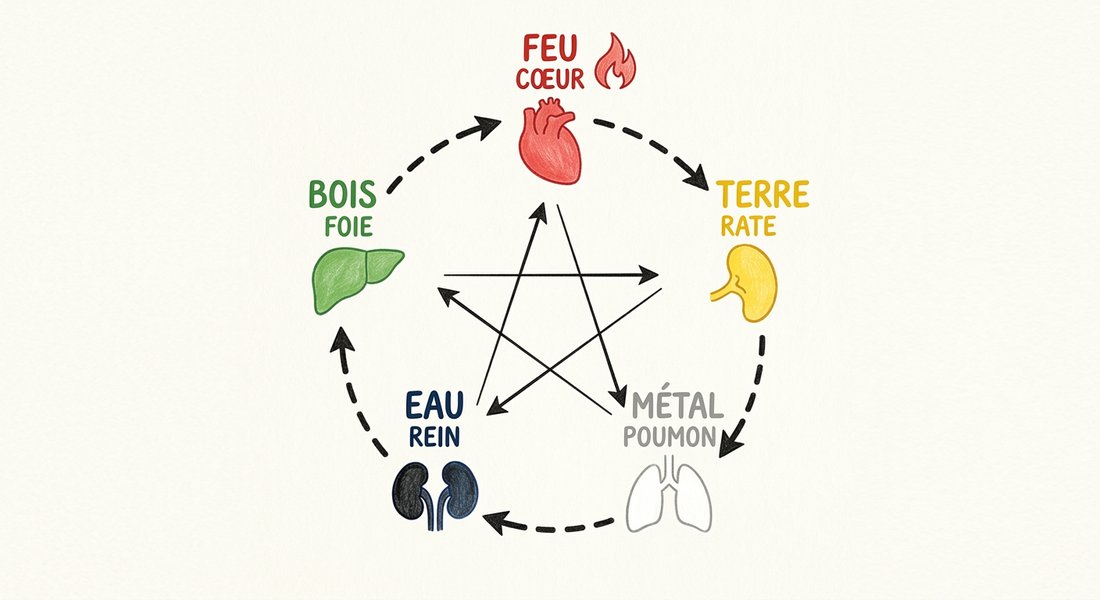
The 5 Elements are organised around two major cycles, shown below:
The generating cycle (Sheng): each element nourishes the next, like a chain of generations — Wood feeds Fire (as wood feeds a flame), Fire produces Earth (ash), Earth bears Metal (ore), Metal enriches Water (dew forming on metal), Water nourishes Wood (a tree needs water).
The controlling cycle (Ke): each element restrains another to prevent excess, like a regulating system — Wood controls Earth (roots hold the soil in place), Earth controls Water (a dyke holds back the river), Water controls Fire (it puts it out), Fire controls Metal (it melts it), Metal controls Wood (an axe cuts the tree).
A patient under work stress, with tension in the upper back, digestive trouble and growing irritability: reading this through the lens of the 5 Elements, one can see a constrained Wood (Liver) “invading” Earth (Spleen-Stomach) beyond its normal controlling role — hence the digestive trouble occurring alongside emotional tension. Treatment would then aim to calm Wood while supporting Earth, rather than treating the two symptoms separately.
This framework explains why an acupuncturist physician sometimes asks questions that, at first glance, seem unrelated to the reason for the visit (sleep, digestion, emotions, menstrual cycle…): it is this overall view, linking the organs together through these two cycles, that makes it possible to identify the underlying cause rather than treating the symptom alone.
These explanations are provided for educational purposes, to help you better understand the logic of Chinese medicine. They do not replace a medical consultation.