In Chinese medicine, winter is the season of Water and the Kidneys: the season of rest and storing. Understanding this logic helps you build meals that warm, nourish and prepare for spring.
By Dr Alexandre Fleury · Physician acupuncturist · ~10 min read · Updated November 2026
 Chinese dietetics
 rests on a simple idea: human beings are part of nature and follow its rhythms. What is right in summer is not necessarily right in winter. So this is not a fixed diet, but a way of adjusting your plate throughout the year.
Winter, which in Chinese tradition runs from early November to early February (roughly November 7 to February 3), is the most Yin season of the year: cold, darkness, stillness. On this page I explain the logic of the season, then how to put it into practice in your meals.
In the theory of the 5 Elements, winter corresponds to Water. Each Element links a season to organs, a flavour, a colour and an emotion. These correspondences provide a framework for understanding what is called upon in winter.
| Correspondence | For winter (Water element) |
|---|---|
| Organ and bowel | Kidneys (Shen 肾) and Bladder |
| Flavour | Salty |
| Colour | Black, dark blue |
| Climate | Cold |
| Emotion | Fear |
| Tissues and sense organs | Bones, ears, hair |
| Movement | Descending, storing, preserving |
In Chinese medicine, the Kidneys do not refer only to the anatomical organ. They represent the body’s deep reserves: the Essence (Jing), received at birth and maintained throughout life, and the body’s basic warmth (Kidney Yang). Winter is the season for protecting and rebuilding these reserves.
The second chapter of the Su Wen (first part of the Huangdi Neijing, written more than 2,000 years ago) describes the three winter months as the period of “closing and storing” (闭藏, bi cang). Water freezes, the earth cracks: it is a time not to disturb Yang. The text gives very practical advice, which I summarise as follows:
The text states that going against this rhythm tires the Kidneys and is paid for in spring, with a lack of drive. Winter eating follows the same logic: nourish and preserve rather than spend.
In Chinese dietetics, each food has a nature (its thermal effect on the body): cold, cool, neutral, warm or hot. In winter, the basis of the diet is neutral and warm foods, complemented by a few hot foods (spices, warming meats). Cold foods are not forbidden, but they are warmed by cooking or combined with warm foods.
Cooking brings warmth to food. Slow, long cooking (stews, soups, braising, oven cooking) suits winter best. Quick cooking and raw food are better suited to summer.
According to tradition, winter is not the season for fasting or restrictive diets. Three hot, regular meals, with a cooked breakfast, support energy better than skipped meals compensated by sugary snacks.
Here are the main foods tradition associates with winter, grouped by family. There is no need to eat them all: choose the ones you like and can easily find near you.
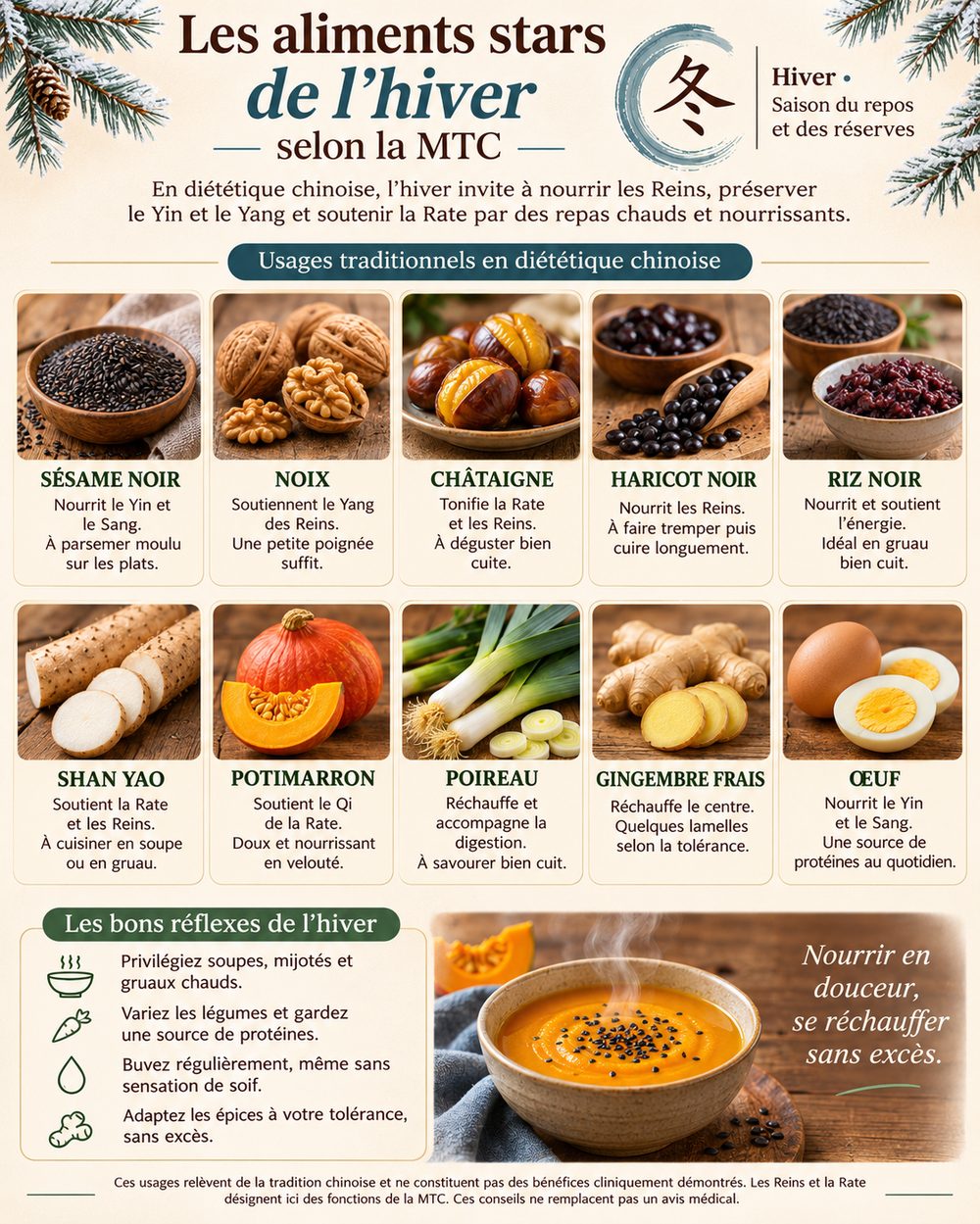
| Family | Foods | Interest according to tradition |
|---|---|---|
| Grains | Rice (as porridge), black rice, oats, buckwheat, glutinous rice | Support the Spleen; black rice is associated with the Kidneys |
| Legumes | Black beans, azuki beans, lentils, chickpeas | Nourish the Kidneys; soak and cook slowly |
| Vegetables | Squash, red kuri squash, carrot, leek, onion, cabbage, turnip, sweet potato, shan yao (Chinese yam) | Sweet and nourishing; leek and onion are warming |
| Seeds and nuts | Walnuts, chestnuts, black sesame, pumpkin seeds | Associated with the Kidneys and Essence; walnuts and chestnuts are warm |
| Fruit | Red dates (jujube), goji berries, longan, cooked apples and pears | Nourish Qi and Blood; fruit is eaten cooked or dried |
| Animal protein | Lamb, beef, chicken, eggs, fish and prawns | Lamb and chicken are warming; eggs nourish Yin and Blood |
| Spices and aromatics | Ginger, cinnamon, clove, star anise, pepper, cooked garlic | Warm and aid digestion, in small doses |
| Natural salty flavour | Seaweed (cooked, in small amounts), miso, soy sauce | Directed towards the Kidneys; use in moderation |
Chinese dietetics adapts to each person. The three profiles below are simplified guides, not a diagnosis: only an assessment in consultation can define your constitution.
Cold hands and feet, need for warmth, fatigue, craving for hot drinks: tradition speaks of Yang deficiency. Warm and hot foods are then reinforced: lamb, chicken, walnuts, chestnuts, cinnamon, ginger, leek. Raw and iced foods are strictly avoided.
Dry skin, chapped lips, restless sleep, a feeling of heat in the evening: tradition speaks of Yin deficiency, often made worse by central heating. Neutral, nourishing foods are favoured: black sesame, eggs, black rice, shan yao, cooked pears, soups. Strong spices, alcohol and grilled foods are moderated.
Slow digestion, bloating, heaviness, tiredness after meals: tradition speaks of dampness and a tired Spleen. Meals are lightened, dairy, sugar and fat are limited, and cooked grains, vegetables and a touch of ginger are favoured.
| Time | Example |
|---|---|
| Breakfast | Cooked oat porridge with cinnamon, red dates and walnuts; hot infusion |
| Lunch | Beef or lamb stew with carrots and ginger, rice |
| Snack | A few roasted chestnuts or a baked apple |
| Dinner | Winter vegetable soup, poached egg, wholemeal bread |
From late January, Chinese tradition invites us to gently prepare the transition to spring, the season of Wood and the Liver. Days grow longer and energy begins to rise.
You can then gradually lighten very rich dishes, reduce warming meats a little and reintroduce green vegetables (leek, cabbage, cooked spinach) and a few young shoots. The idea is not to change your diet abruptly, but to accompany the movement of nature.
The notions of nature, flavour, Yang or the Water element belong to traditional Chinese medicine. They offer a coherent framework, but their effects have not been demonstrated by clinical studies in the sense of modern medicine.
The winter diet described here nevertheless matches current nutritional recommendations: seasonal vegetables, legumes, whole grains, nuts, moderation of salt and alcohol.
A few precautions:
Fatigue or sensitivity to cold lasting several weeks deserves medical advice. In consultation, I can also offer dietary advice suited to your constitution.
This information comes from traditional Chinese dietetics and does not replace medical advice. The Kidneys, the Spleen, Qi and Yang refer here to notions of Chinese medicine, not to organs or physiological data in the Western sense.
Foods, cooking methods and simple habits for the season.
02Ten traditional foods and how to cook them.
03Keeping warm and energised in winter.
04The Chinese date in dietetics and herbal medicine.
05Complete recipes to cook.
06Discover the Kidney and Bladder meridians.