Cold hands, a dip in energy at the end of the day… Winter puts our warmth and energy to the test. Chinese dietetics suggests a few simple foods to support it. Here are five, easy to find and to cook.
By Dr Alexandre Fleury · Physician acupuncturist · ~5 min read · Updated November 2026
 Chinese dietetics
In winter, I often hear two complaints together in my consultations: “I’m always cold” and “I’m tired”. Chinese medicine naturally links them, because the body’s warmth and its energy are two sides of the same reserve.
Here I present five foods that tradition uses to warm the body and support energy: a spice, a meat, a broth, a dried fruit and a grain. Nothing exotic or miraculous: everyday foods, well chosen and well cooked.
In Chinese medicine, two notions describe what we feel as “energy” and “warmth”:
Winter challenges both: outside cold consumes Yang, and short days invite us to slow down. Hence the value of foods that are warm or hot in nature, which warm us, and foods that are sweet and nourishing, which support Qi.
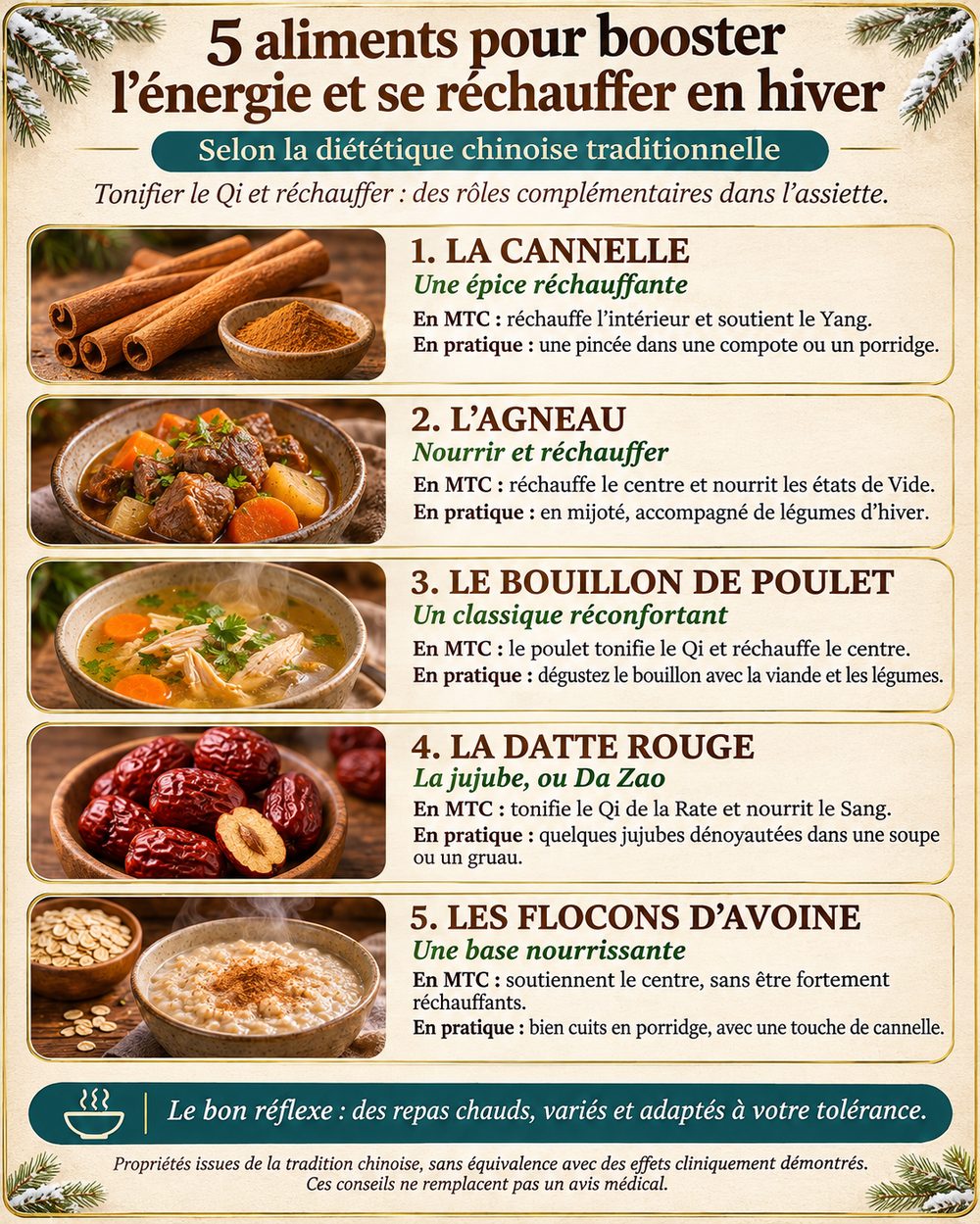
Pungent, sweet and hot in nature, cinnamon is one of the most warming substances in the Chinese pharmacopoeia. Tradition uses it to support Yang, drive out cold and promote circulation, especially when hands and feet stay cold.
In practice: a pinch in a porridge, an apple compote or an infusion. A small amount is enough: it is a powerful spice.
Sweet and warm, lamb is said to warm the centre and the Kidneys and to support Qi. A classic recipe of Chinese medicine, described nearly 1,800 years ago by Zhang Zhongjing, combines lamb, ginger and Chinese angelica in a winter soup.
In practice: as a stew or navarin, with carrots, onions and a few slices of ginger. Once a week is enough, favouring lean cuts.
Chicken is considered sweet and warm. It supports Qi and warms the stomach. As a long-simmered broth, it is both nourishing and very easy to digest: a convalescence dish in many cultures.
In practice: simmer a chicken carcass or thighs for 2 to 3 hours with carrot, leek, onion and ginger. Drink the broth as it is or use it as a base for a vegetable or noodle soup.
Sweet and warm, the Chinese red date has been used for centuries to support Qi, nourish Blood and calm the mind. It appears in a great many Chinese formulas and recipes (see also my article on the jujube).
In practice: 3 to 5 dates a day, in a porridge, a broth or as an infusion with a few slices of ginger. You can find them dried in Asian grocery stores.
Sweet, neutral to warm in nature depending on the author, oats are considered to support the Spleen and give lasting energy. They are a simple way to start the day with a hot meal.
In practice: as a cooked porridge (not cold muesli), with a pinch of cinnamon, a few dates and crushed walnuts.
There is no need to eat everything on the same day: this example simply shows how these foods fit into ordinary meals.
| Time | Meal idea |
|---|---|
| Breakfast | Cooked oat porridge, cinnamon, 3 dates, a few walnuts |
| Lunch | Lamb navarin with carrots and ginger, rice |
| Afternoon snack | Ginger and red date infusion |
| Dinner | Chicken broth with vegetables and noodles |
The properties described here (“warming Yang”, “supporting Qi”) belong to traditional Chinese dietetics. They have not been demonstrated by clinical studies, and no food “boosts” energy the way a medicine would.
What can be said, however, is that a hot, regular and complete meal (protein, grains, vegetables) helps avoid the energy dips linked to skipped or overly light meals. Oat flakes, for example, provide complex carbohydrates and fibre, which give steadier energy than a sugary breakfast.
When to see a doctor? Fatigue lasting several weeks, unusual sensitivity to cold or breathlessness should not be put down to winter without being investigated: anaemia, iron deficiency, thyroid problems or sleep disorders may be the cause. Talk to your doctor. In an acupuncture consultation, I can also offer dietary advice suited to your constitution.
This information comes from traditional Chinese dietetics and does not replace medical advice. Qi, Yang, the Spleen and the Kidneys refer here to notions of Chinese medicine, not to physiological data in the Western sense.
Foods, cooking methods and simple habits for the season.
02Ten traditional foods and how to cook them.
03The Chinese date in dietetics and herbal medicine.
04The complete guide: Water element, principles, foods and recipes.
05Complete recipes to cook.
06Discover the Kidney and Bladder meridians.