Black sesame, walnuts, chestnuts, black rice, shan yao… In winter, Chinese dietetics favours warm, nourishing foods to support the season of rest. Here are ten traditional foods, how to cook them, and what can honestly be said about them.
By Dr Alexandre Fleury · Physician acupuncturist · ~7 min read · Updated November 2026
 Chinese dietetics
As the days grow shorter, many of my patients ask me the same question: “What can I eat to get through winter better?” Chinese dietetics has an old and fairly simple answer: eat warm, cooked, nourishing food, following the rhythm of the season.
In this article I present ten foods that tradition associates with winter, with practical ideas for cooking them. I also tell you clearly what belongs to tradition and what science allows us to say, because the two are not the same thing.
In traditional Chinese medicine, each season is linked to an element and to a function of the body. Winter corresponds to Water and to the Kidneys. In nature, it is the time when sap goes down, seeds wait under the ground and animals slow down.
The Huangdi Neijing, the founding text of Chinese medicine, describes winter as the season of closing and storing. The idea is to preserve your energy rather than spend it, so as to start spring with reserves.
An important point: in Chinese medicine, the “Kidneys” refer to a set of functions (energy reserves, body warmth, growth, bones, hearing…). They are not the kidney organ of Western anatomy, which is why I write these terms with a capital letter.
Chinese dietetics does not think in calories, but in nature (cold, neutral, warm, hot) and flavour. In winter it recommends four simple things:
Warming spices (ginger, cinnamon) have their place, in moderation: the aim is to warm up, not to sweat.
For each one, I give its place in Chinese tradition, then a simple way to use it every day.
In Chinese medicine, the colour black is associated with Water, and therefore with winter and the Kidneys.
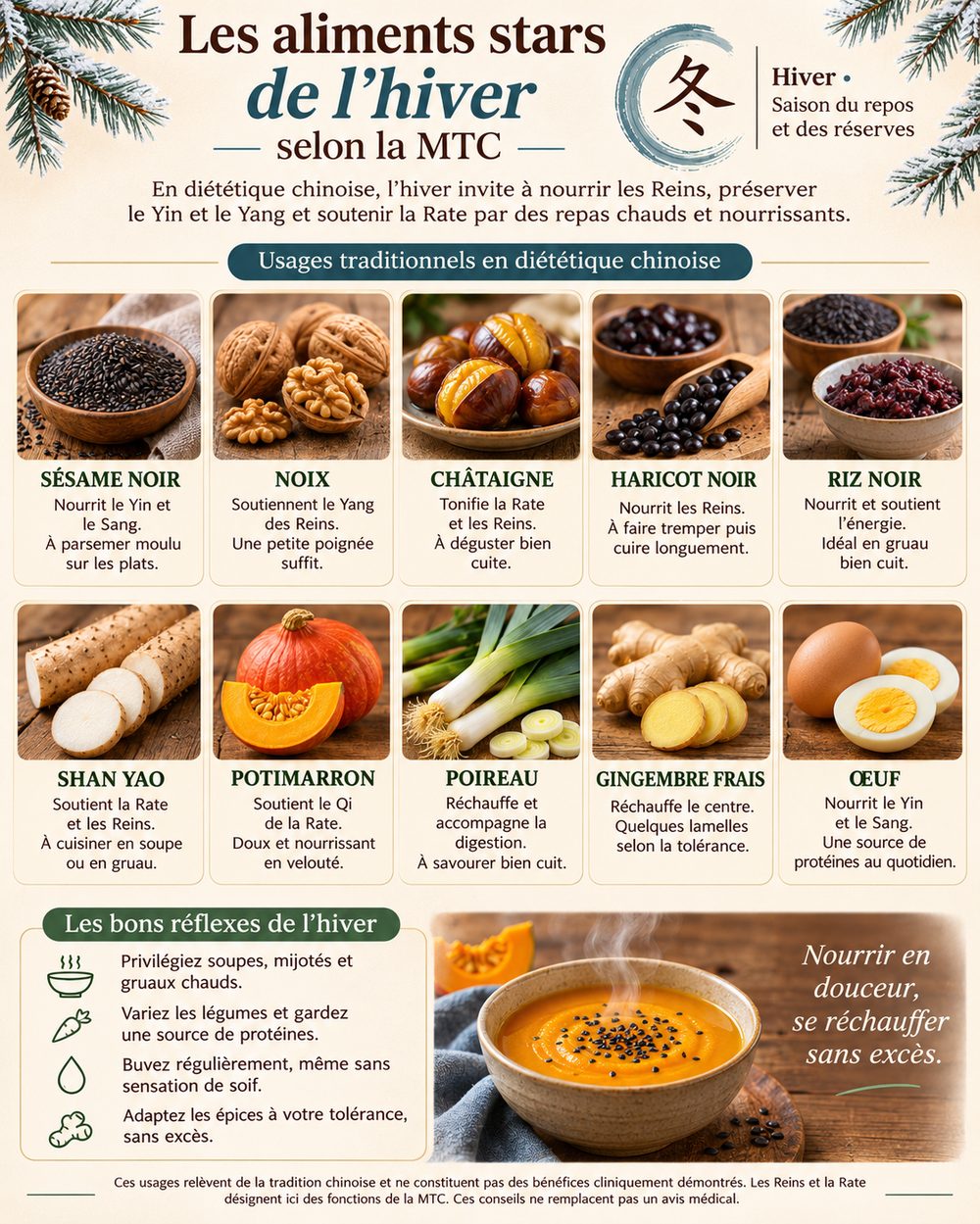
Black sesame. Neutral in nature and sweet in flavour, it is traditionally used to nourish Yin and Blood, and is associated with the hair and with moistening the intestines. In practice: dry-roasted then ground, sprinkled on a soup, a porridge or vegetables.
Walnut. Warm and sweet, the walnut is said to support Kidney Yang, that is, the body’s warmth. In practice: a small handful (3 to 5 kernels) a day is enough, plain or in a porridge.
Black bean. Neutral and sweet, it is traditionally associated with the Kidneys and the smooth circulation of fluids. In practice: soak for 12 hours, then cook slowly with a little ginger or cumin to make it more digestible.
Black rice. Sweet, it is considered nourishing for the Spleen and Kidneys. In practice: ideal as a porridge (congee), mixed with white rice, after soaking overnight.
In Chinese medicine, the Spleen represents the digestive function that turns food into energy. In winter, we spare it so that it can feed the reserves.
Chestnut. Warm and sweet, it is traditionally used to strengthen the Spleen and Kidneys. In practice: always well cooked (roasted, puréed, in soup), as it is hard to digest raw.
Shan yao (Chinese yam). Sweet and neutral, it is a classic food-medicine, said to support the Spleen, Lung and Kidneys. In practice: available in Asian grocery stores. Diced, it goes into soups or porridge. Wear gloves to peel it: its sap can cause itching.
Red kuri squash. Warm and sweet, it is considered to support Spleen Qi. In practice: as a velouté, roasted in the oven or in a stew. Its skin, well washed, can be eaten.
Leek. In Chinese dietetics as taught in the West, it is classed as pungent and warm: it warms and helps digestion. In practice: softened, in soup or in a tart, always well cooked.
Fresh ginger. Pungent and warm, it is traditionally used to warm the stomach and disperse cold. In practice: a few slices in a soup or an infusion, according to your tolerance.
Egg. Neutral and sweet, it is said to nourish Yin and Blood. In practice: cooked (soft-boiled, poached, in a broth). It is also a simple source of protein, useful when you eat a lot of soups.
You will find more ideas in the site’s Recipes section.
Diet is only one part of seasonal advice. The classical texts insist just as much on lifestyle:
The properties described above (“nourishing the Kidneys”, “supporting Yang”…) belong to Chinese tradition. They have not been demonstrated by clinical studies, and I do not present them as treatments.
On the other hand, this winter plate is entirely consistent with modern nutrition. It includes legumes (black beans), nuts (walnuts), seeds, whole grains (black rice), seasonal vegetables and a source of protein (eggs). French public health guidelines recommend pulses several times a week and a small handful of unsalted nuts a day.
In other words: tradition offers a way of reading, nutrition confirms its dietary common sense. The two can coexist, as long as they are not confused.
When to see a doctor? Lasting fatigue, unusual sensitivity to cold, weight loss or persistent sleep problems are not a matter of simple dietary adjustment. They deserve medical advice, as there may be a cause to look for (anaemia, thyroid, etc.). In an acupuncture consultation, I can also offer dietary advice suited to your situation.
This information comes from traditional Chinese dietetics and does not replace medical advice. The Kidneys and the Spleen refer here to functions in Chinese medicine, not to organs in the anatomical sense.
Foods, cooking methods and simple habits for the season.
02Keeping warm and energised in winter.
03The Chinese date in dietetics and herbal medicine.
04The complete guide: Water element, principles, foods and recipes.
05Complete recipes to cook.
06Discover the Kidney and Bladder meridians.