Anger, joy, worry, sadness, fear: how TCM links each emotion to an organ and a meridian.
By Dr Alexandre Fleury · Physician acupuncturist · ~5 min read · Updated October 2026
Chinese medicine does not separate the body from the mind. Each organ is associated with a psychological dimension and a so-called “dominant” emotion. This doesn’t mean we become ill because we feel emotions: they are part of life. It is their excess, their duration, or their being blocked that, according to TCM, ends up affecting the body.
This view is also rooted in Taoist tradition, which speaks of “Three Treasures”: Jing (essence), Qi (breath) and Shen (spirit). Emotions express the movement of Qi and Shen.
TCM describes seven emotions: joy, anger, sadness, worry, excessive reflection (rumination), fear and fright. A classic text, the Su Wen, links each one to a way the Qi moves: anger makes it rise, excessive joy scatters it, sadness exhausts it, fear makes it descend, fright disorders it, rumination knots it.
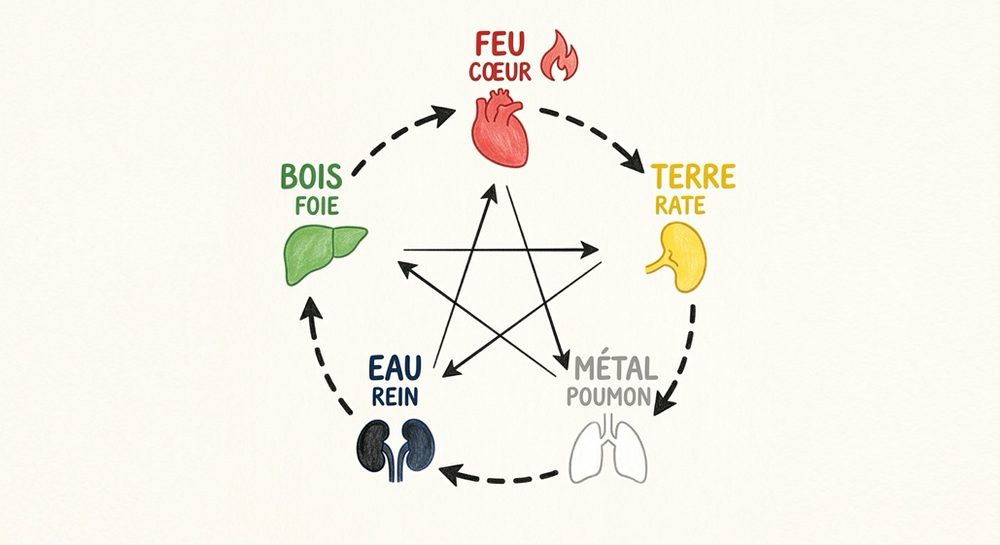
In the theory of the Five Elements, each Yin organ forms a pair with a Yang organ, and each is linked to a dominant emotion:
| Element | Organ and meridian | Dominant emotion | Effect on Qi | Common signs |
|---|---|---|---|---|
| Wood 木 | Liver and Gallbladder | Anger, frustration (怒) | Rises | Neck tension, headaches, irritability, sighing |
| Fire 火 | Heart and Small Intestine | Joy, excitement (喜) | Scatters | Palpitations, restlessness, light sleep |
| Earth 土 | Spleen and Stomach | Worry, rumination (思) | Knots | Slow digestion, bloating, fatigue, looping thoughts |
| Metal 金 | Lung and Large Intestine | Sadness, grief (悲) | Exhausts | Shortness of breath, sighing, a sense of emptiness, constipation |
| Water 水 | Kidney and Bladder | Fear (恐) | Descends | Deep fatigue, low back pain, insecurity |
The Pericardium (Heart Protector) and the Triple Burner, linked to Fire, protect the Heart and regulate heat in the body. Fright (惊), a sudden emotion, affects both the Heart and the Kidney.
The five elements influence one another: this is the controlling cycle. For example, Wood (Liver) “controls” Earth (Spleen). Suppressed anger can thus disturb digestion, something many of us have already felt (the “knotted stomach” after an upset). Similarly, constant rumination exhausts the Spleen and can feed sadness.
Tradition even says each emotion can temper another. These are reading frameworks, not absolute rules: an irritable person does not “necessarily” have a Liver problem.
For me, emotions are clues, among others, in the interview: they shed light on the overall picture, help choose which meridians to treat, and help understand how the body expresses what the person is going through. This reading does not replace medical or psychological advice. If you are going through a period of persistent sadness or intense anxiety, talk to your doctor (see the article on “Stress”).
This article is intended for information and education. It does not replace a medical consultation and does not constitute personalised advice.