Moxibustion of the Zhiyin point to help turn the baby: what research says and how it works.
By Dr Alexandre Fleury · Physician acupuncturist · ~4 min read · Updated October 2026
Towards the end of pregnancy, about 3 to 4% of babies are still in breech presentation, head up. Before 32 to 34 weeks, this is common, and many babies turn spontaneously. When this isn’t the case, several options exist, and moxibustion, a traditional Chinese technique, can be offered as a complement.
The obstetric team may offer an external cephalic version (ECV), performed at the maternity unit around 36–37 weeks, or discuss a vaginal or caesarean birth in breech presentation. These options should be discussed with your midwife or obstetrician.
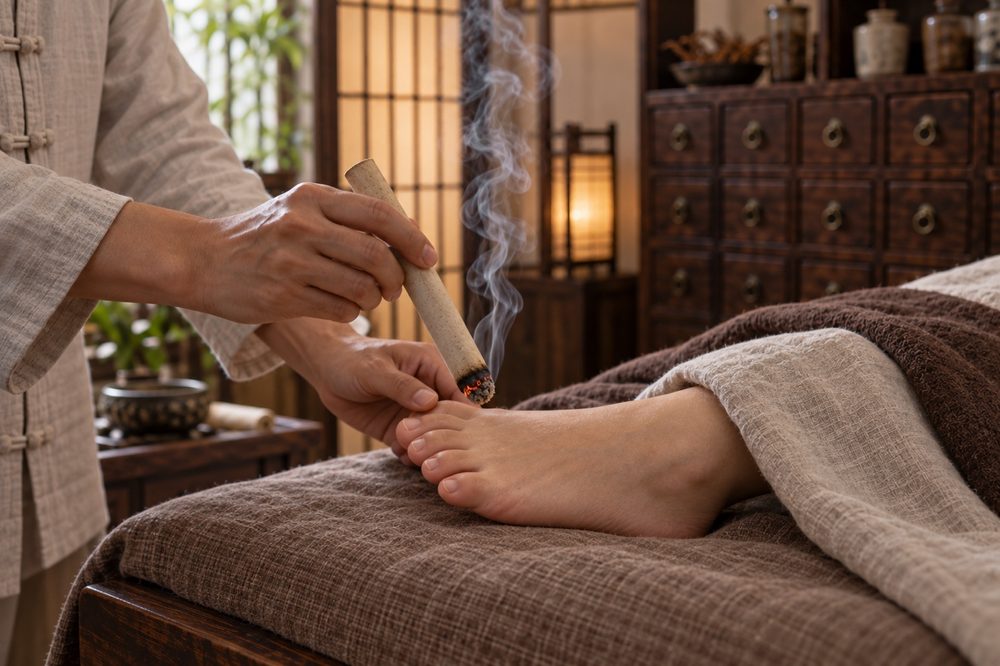
It involves applying heat to an acupuncture point using a mugwort stick (moxa) held near the skin, without touching it. The point used is Zhiyin (Bladder 67), located on the little toe, at the outer corner of the nail. Its name means “reaching Yin.”
In TCM, this stimulation warms and moves the energy of the Bladder meridian, which connects to the Kidney. One modern hypothesis is that this stimulation increases the baby’s movements; this is not proven.
The latest Cochrane review (2023, 13 studies, more than 2,000 women) concludes that moxibustion combined with usual care probably reduces the number of babies still in breech position at birth (moderate-certainty evidence). However, it does not appear to reduce the caesarean rate. Adverse effects, poorly reported in the studies, include more vigorous baby movements, contractions, nausea and skin burns if the stick is held too close to the skin.
I offer this approach from around 34–35 weeks, in the absence of any obstetric complication. Depending on the case, one or more sessions at the practice, sometimes supplemented by sessions at home, for which I explain the technique. This does not replace your pregnancy follow-up: continue your appointments with your midwife or obstetrician.
There is no needle: you feel warmth, generally pleasant, which must be stopped as soon as it becomes too intense. It should never burn. Air out the room, as moxa gives off smoke.
When should you seek prompt medical advice?
This article is intended for information and education. It does not replace a medical consultation and does not constitute personalised advice.