Yu Ping Feng San, Bai He Gu Jin Wan, Liu Wei Di Huang Wan: three traditional formulas to support immunity and prepare for winter.
By Dr Alexandre Fleury · Physician acupuncturist · ~5 min read · Updated October 2026
 Chinese herbal medicine
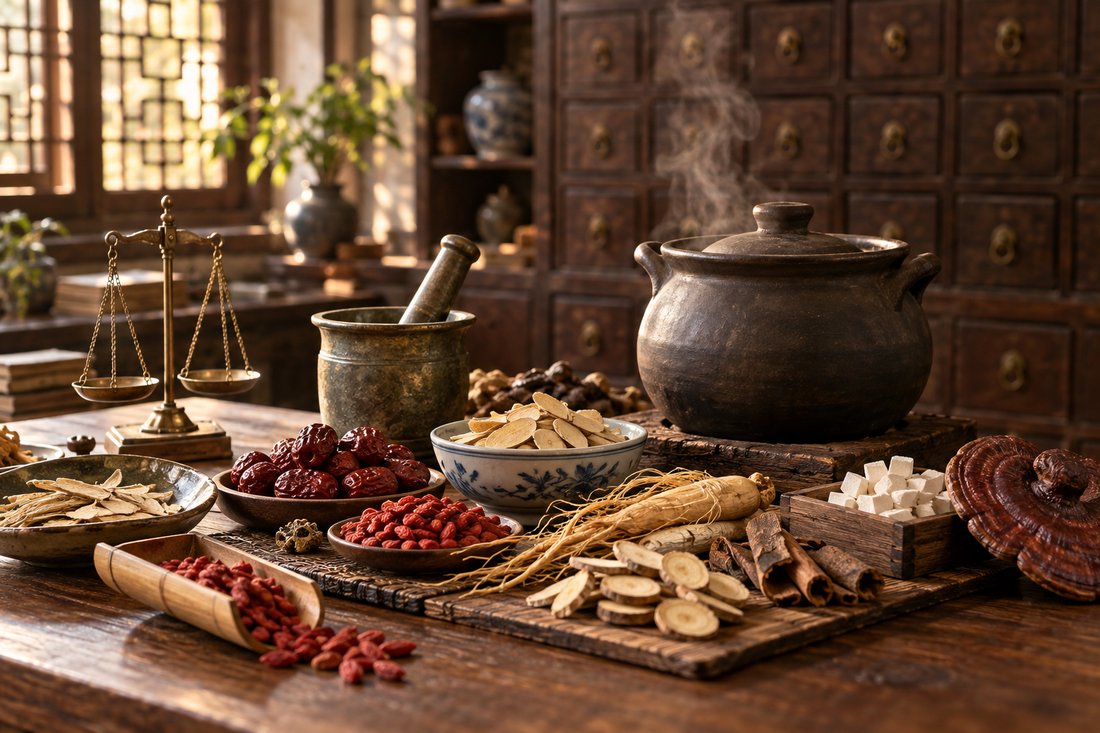
Beyond diet, traditional Chinese herbal medicine (pharmacopoeia) offers plant-based preparations (often as capsules or dissolvable powders) designed to support seasonal change. In autumn, the aim is twofold: to support the body’s natural defences before winter, and to counter the dryness that affects the Lung. Here are three classic formulas, still used today.
Important: these preparations are food supplements or traditional preparations, not medicines. They should never replace an ongoing treatment or medical advice, and some are not recommended for children, during pregnancy/breastfeeding, or alongside anticoagulant treatment. Always ask your doctor or a pharmacist for advice before starting a herbal preparation.
This very classic formula combines three herbs: Astragalus (Huang Qi), the reference tonic for Wei Qi (defensive energy, a kind of immune shield in Chinese medicine); Siler root (Fang Feng), which protects against external attacks; and Atractylodes (Bai Zhu), which supports digestion and energy. It is traditionally offered as a preventive measure, at the start of the season, for people prone to recurrent colds or fatigue.
Not recommended for children under 12, during pregnancy/breastfeeding, with anticoagulant treatment, or with a history of hormone-dependent cancer.
Made up of eight herbs (including lily bulb, Bai He, and rehmannia), this formula aims to nourish Yin (the body’s fluids and coolness, in Chinese medicine) and moisten the Lung. It is traditionally associated with respiratory comfort in cases of marked dryness (dry throat, dry cough without phlegm) — a common issue in autumn.
For adult use only, not recommended during pregnancy/breastfeeding or in cases of hypertension, or heart, kidney or liver disease. Use limited to a few weeks without professional advice.
A great classic of Chinese herbal medicine, this six-herb formula (including prepared rehmannia, Chinese yam and cornus fruit) aims to tonify Liver and Kidney Yin. It is more often used in late autumn and winter, to support underlying energy — in keeping with the TCM principle of “nourishing the Kidneys” before the cold season (see our article on winter).
For adult use only, not recommended during pregnancy/breastfeeding; its use is best guided by professional advice rather than self-medication.
These formulas are offered by several laboratories specialising in Chinese herbal medicine (including the Calebasse laboratories, whose detailed product sheets were used as a reference for this article), in pharmacies or specialised shops. The safest approach remains to discuss it in consultation: as a physician trained in TCM, I can help you choose the preparation best suited to your constitution, or refer you to a qualified herbalist.
This article is purely informational and does not constitute a prescription. I am not affiliated with any laboratory mentioned.
The reference article on autumn dietetics.
02A targeted selection for the ENT sphere.
03The full overview of seasonal foods.
0414 complete recipes to cook.
05Dates, general principles and lifestyle rhythm associated with the season.
06Discover the Lung and Large Intestine meridians.